Wednesday, 12 February 2014

Jeshurun's Mind: How To:


How To Measure Bra Size
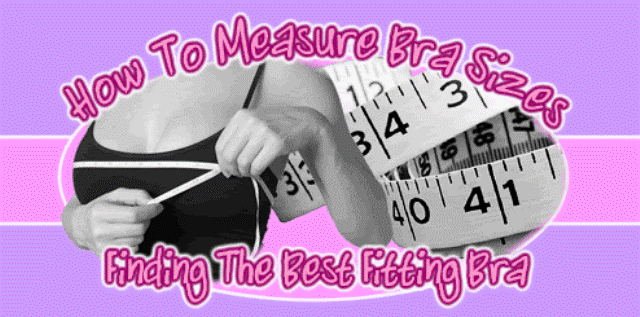


Surprisingly, so many women wear the wrong bras despite there being a wide range of sizes and styles available. An unsuitable or ill-fitting bra can cause health problems such as chronic headaches, irritation and straining on shoulder joint structures, back pain in lower spinal region, and cervical spine problems among others. 

You can easily tell whether you are wearing the right bra size if there is no wrinkling in the cups, cup spillage, slipping straps, poking of the sides of your breast by underwires, hiking up of the bra when the arms are raised, or general discomfort.   


The best way to counter all of the above mentioned problems and to get a well-fitting, comfortable bra is to get the correct bra size. This can be achieved by knowing how to measure bra size.

1. Determine Band Size

The first step in measuring your bra size is to determine your band size.  While wearing a non-padded bra, take a measuring tape, keep it parallel with the ground, and then measure around the bra, at the bottom of the band directly under your bust. You should exhale all air from your lungs when doing the measurement.
 

If you get fractional measurements, round them to the nearest whole number. Then take the measurement to the Band Size Chart shown below.

Band Size Chart
If Under Bust Measurement (In inches) is:
25
26
27
28
29
30
31
32
33
34
35
36
37
38
Your Band Size is:
30
30
30
32
32
32
34
34
34
36
36
36
38
38

If the Under Bust Measurement is beyond 38, the band size will be the even number closest to the actual measurement. For example if the Under Bust measurement is 39, the Band Size will be 40. If the Under Bust measurement is 41, the Band Size will be 42 and so on.
    
    2.  Measure the Cup Size

The next step is to determine your cup size. This is achieved by placing the tape measure around the fullest part of the bust (the nipple level), while keeping the measuring tape parallel with the ground. Round off that measurement to the nearest whole number.


To get your Cup Size, subtract the Band Size from the Cup (Bust) Measurement. Use the Chart shown below to determine your Cup Size.

Difference (In inches)
0
1
2
3
4
5
6
7
Your Cup Size is:
AA
A
B
C
D
DD
DDD,F
G

For example if your Cup Measurement is 37 inches and your Band Size is 34 inches, the difference will be 3 inches. Your cup size will therefore be C, which makes your Bra Size to be 34C.

Having known how to measure bra size, you can try out a few tips to ascertain if a particular style would fit you.

For example, you can check whether a bra is too tight or too loose by trying to slide one finger underneath the band. If the finger slides comfortably, then the bra is well-fitting but if 3 or more fingers can slide in, then the bra is too loose.

Should you feel the need to scale up to a bigger cup size for fit, go down one band size, and vice versa. 

When determining your correct Bra Size, it is best to first find the best band size for you, and then keep on adjusting the Cup Size until you find get the one that fits best. 

Wednesday, 5 February 2014

Jeshurun's Mind: Health and Fitness


Ten Long Term Benefits Of Martial Arts For Kids


There are a number of misconceptions about martial arts training for kids. For instance, some people think that the kids will turn violent or become bullies, oblivious that martial arts is based on non-violence. Furthermore, martial arts training does not only encompass the physical aspect of life, but also emotional and mental lessons as well.

1. Builds Self-Esteem 

Many kids’ activities and sports involve fierce competition and sometimes the demand to win at all costs. This not only causes the kids to be aggressive and moody, but also leaves them grappling with self-esteem issues. On the contrary, martial arts build self-esteem and confidence, as well as courtesy, respect and concentration. 

2. Self Defense 

Even though kids cannot always take on every opponent that comes their way, especially during confrontations, they can use the learned techniques to defend themselves and prevent escalation of assaults. The knowledge that they can defend themselves gives them peace of mind and also empowers them to deal with their problems through non-violent means. 

3. Fosters Self-Discipline

Contrary to the myth that it promotes violence and indiscipline, martial arts training actually fosters self-discipline in kids and equips them with socialization, concentration and self-control skills. Disciplined kids often find themselves doing what they must do even when they don’t feel like doing them it. 

4. Teaches Respect 

Normally, during martial arts training, kids learn a lot about respect either from bowing to the teacher or master before starting or ending classes, uttering certain phrases or words, or standing still and awaiting the next command. This valuable lesson is often carried outside the dojo to other places such as schools. This in turn teaches them to respect other people and helps to improve their behavior and also grades. 

5. Instills Leadership Skills 

Apart from offering martial arts training programs for kids, many martial arts schools also teach kids leadership courses. Teaching martial arts beginners, for instance, forms part of becoming a black belt. This means that on the way to becoming a black belt or even during regular training, a kid will at one time, have to teach other young students. This helps the kids develop leadership skills. 

6. Helps in Goal Setting 

Martial arts training is based around a system of accomplishments which entail getting a certain colored belt before proceeding to the next level. By striving toward each belt and undergoing tests for every new level, a kid will acquire valuable experience on setting, prioritizing and achieving specific goals. 

7. Improves Physical Fitness 

Martial arts training encourages physical activity in kids and is a great way to getting them off the couch, other than limiting their screen time. Most martial arts training incorporate intense training which helps in reducing childhood obesity and improving the kids’ muscular strength and cardiovascular fitness. 

8. Builds Strength and Endurance 

As a sport, martial arts help in building strength and endurance. Martial arts training is ideal especially for kids who do not excel in team sports. This is because it gives them the ability and opportunity to flourish in it, while at the same time combining mental and physical practices. 

9. Increases the ability to learn 

Most martial arts programs require deep concentration and strict attention. Having to concentrate and even memorize certain terms, sometimes under pressure, increases the ability to learn. This enhanced learning ability can then be used in school or elsewhere. Mastering martial arts skills also requires excellent listening skills. By learning how to listen attentively, a kid can greatly benefit from verbal instructions and one-on-one training in the dojo, school, home or elsewhere. 

10.  Improves the overall life of a Kid 

The enormous benefits of martial arts for kids go beyond the dojo. For instance, high self-esteem, confidence, increased ability to learn and being physically fit, just to mention a few, help the kid to easily navigate the social and academic aspects of school and generally improve his or her life. This ensures that kids get an all-round positive influence on them as they develop into adults.   

Wednesday, 1 January 2014

Jeshurun's Mind: Kiswahili na Mashairi


WAITE na MRISHO MPOTO

Waitee..eeee…eeee…
Waite….waite wakalishe chini…waite..
Watoe hofu kwanza…waite…              
Waambie wao hawamo, japo nao walikula…aaaa...eeee…waite…
Waite…ite…waite…ite…waite… waite…ite…waite…ite…waite…

Mjomba, chutama. Sisi ni waungwana, na muungwana akivuliwa nguo, mara nyingi huchutama. Kuna baadhi ya michezo ukishindana peke yako, lazima uwe mshindi. Lakini kwa mchezo ule, uliwahitaji ili kuongezea mashabiki na washangiliaji wenye sauti zisizokauka, japo mwiba wa kujichoma hauna pole...Tusiunganishwe na mto wakati kuna ngalawa mjomba.

Walivyoanza mjomba hakuna aliyedhani. Kwanza walifika mapema, mmoja wao akaandikisha jina lake kwa niaba ya wengine, japo wote wana majina yao na hayafanani. Jina lako nani? MIMI. Unatoka wapi? KWETU. Unakwenda wapi? HUMU NDANI. Kikazi au binafsi? NANI? MIMI? AH...AH...AH...Wakaingia...HAUJACHELEWA MJOMBA, WAITE.

Waite…ite…waite…ite… waite… waite…ite…waite…ite…waite…×2

Mjomba ukipewa kazi ya kuosha maiti,
Siku zote wewe ni zaidi ya ndugu, wanaamini huwezi kuidhuru,
Waliingia, wakajipanga kwa sauti zao, ya kwanza mpaka ya nne,
Wakaanzisha mapambia, basi ikawa hivyo tu,
Watu wakilia kazi yao wanatoa pole,
Watu wakilia wanatoa pole,
Na waandishi kwa utashi wao wakaandika:
Msiba umefana kweli, hakuna aliyelia nje ya key,

Waite…

Mjomba, ushauri wangu waite,
Wakalishe chini, watoe hofu kwanza,
Kisha uwaambie: Muungwana hanuni kwa mashavu hununa moyoni,
Wao hawahusiki wala hawamo, waje tu kuwa mashahidi,
Kwa kuwa nao walikuwepo, na walikula,
Ijapokuwa, hawakujua umemtoa wapi mbuzi yule,
Ushahidi wao mjomba utakusaidia kwa vitu viwili:
Kuingia kwenye historia au kushinda kesi,
Siku zote, mjomba mimi huwa nakuambia:
Anayekula kwa mikono miwili, hawezi kushiba kamwe, NEVER!

Mimi pia nakumbuka, kweli nilimwona,
Alikuwa mbuzi tena mdogo tu,
Wala hakuwa ng’ombe kama wanavyodai,
Hii ni zawadi tunakupa, nenda ukale utukumbuke, utukumbuke,
Leo hii wanasema alikuwa ng’ombe mdogo,
Wengine eti ooh…kweli… alikuwa mbuzi…lakini angekua angekuwa ng’ombe,
Mjomba, kuna aina tatu tu za kujibu maswali:
Swali kwa swali, swali kwa maelezo na swali kwa mkato,
Wajibu tu kwa mkato: Alikuwa mbuzi mdogo tumemla akaisha…basi!

Waitee..eeee…eeee…
Waite….waite wakalishe chini…waite..
Watoe hofu kwanza…waite…              
Waambie wao hawamo, japo nao walikula…aaaa...eeee…waite
Waite…ite…waite…ite…waite… waite…ite…waite…ite…waite…